







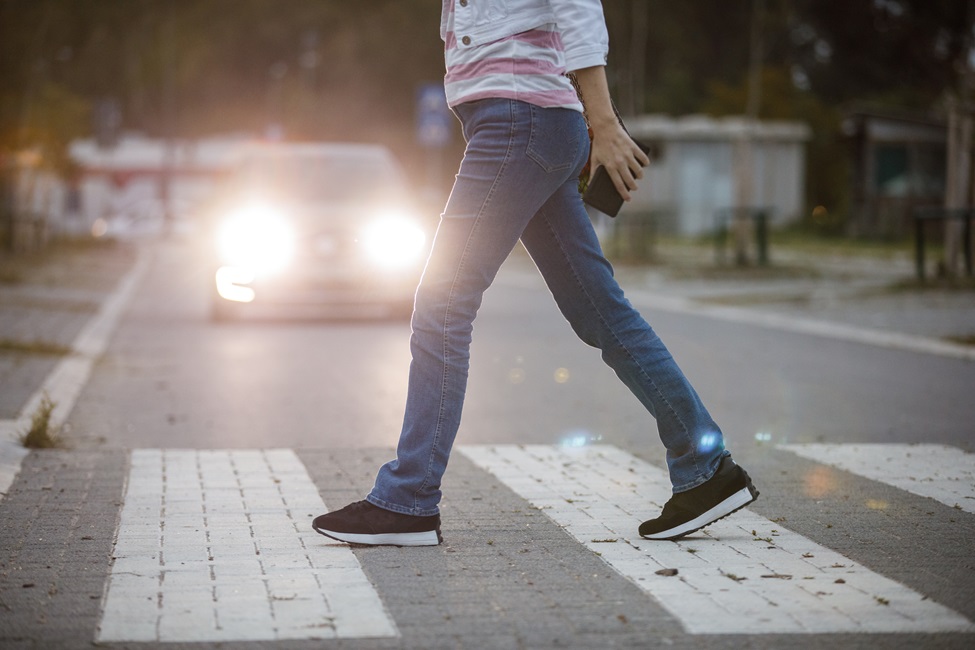
Lower income communities experience fully three times the number of pedestrian deaths and injuries per capita as do affluent ones.
Pedestrian fatalities in the United States have increased more than 50% over the last decade, with 1 in 6 traffic deaths involving pedestrians. Programs like Vision Zero and Safe Systems focus on making transportation safe for vulnerable users, primarily pedestrians, based on the assumption that pedestrian-related improvements will enhance safety regardless of where they are applied.
Despite the widespread implementation of these programs, they have generally failed to reduce traffic-related deaths and injuries. Even cities that have most aggressively adopted Vision Zero, like New York, Washington D.C., Seattle and Portland, have seen increases in traffic-related fatalities and injuries after implementing these programs.
Research from Florida Atlantic University examined the environmental factors associated with crash incidence in lower-income and more affluent areas in Broward and Palm Beach counties, finding that much of the failure of these programs may be attributed to the failure to direct pedestrian safety improvements to the areas and populations that would most benefit from them.
Results of the study, published earlier this year in the journal Transportation Research Record, show that the nature of pedestrian crash risk is markedly different in lower income communities than in more affluent ones. Lower income communities experience fully three times the number of pedestrian deaths and injuries per capita as do affluent ones.
The environmental factors associated with crash risk in these areas differ as well. For lower-income communities, pedestrian deaths and injuries increase with traffic volumes, multilane streets, and presence of restaurants and shopping centers. These variables all suggest that, at least in lower-income areas, pedestrian death and injury is associated with difficulties safely accessing household-supporting destinations.
For affluent areas, the factors associated with increased pedestrian death and injury were those relating to recreation and nightlife – specifically, bars and clubs, hotels and restaurants – rather than essential household travel. Neither high traffic volumes nor multilane “arterial” roads, which tend to be the focus of Vision Zero-related safety programs, were meaningfully related to pedestrian death or injury in affluent areas.
Although pedestrian crashes often are attributed to pedestrians walking under the influence of drugs or alcohol, it appears that walking under the influence is principally an issue for affluent populations, rather than lower income ones. Bars and nightclubs were only associated with increased pedestrian crashes in affluent areas, with pedestrians struck by a vehicle in affluent ones being twice as likely to have been suspected of being under the influence of drugs and alcohol than those in lower income ones.
“Pedestrians in lower-income areas are likely to be struck by a car because they are trying to access everyday needs like food and shopping in environments that are poorly designed,” said Eric Dumbaugh, Ph.D., senior author and a professor in the Department of Urban and Regional Planning, within FAU’s Charles E. Schmidt College of Science. “This isn’t the problem in affluent areas. If a street feels unsafe, they don’t need to walk. They simply drive instead.”
The researchers note that streetscape projects intended to advance economic development objectives or to enhance the lifestyle preferences of affluent communities are often heralded as “safety improvements,” despite little evidence to suggest that such improvements will result in reductions to crash risk.
“There is a tendency to prioritize pedestrian projects in affluent areas where pedestrian safety isn’t really a problem. If we want to get serious about pedestrian safety, we need to begin directing safety improvements to the areas that will most benefit from them,” said Dumbaugh. “Looking forward, the definition of vulnerability incorporated in road safety programs needs to be understood not simply as a function of a human body’s physical tolerance for trauma, but also as an outcome of underlying social disparities, with race and income particularly relevant risk factors.”
Study co-authors are Jonathan Stiles, Ph.D., a post-doctoral researcher at FAU; Diana Mitsova, Ph.D., chair and professor of FAU’s Department of Urban and Regional Planning; and Dibakar Saha, Ph.D., Florida Department of Transportation.
This project was partially supported by grants from the Florida Department of Transportation and the Collaborative Sciences Center for Road Safety, based at the University of North Carolina at Chapel Hill, a U.S. Department of Transportation National University Transportation Center promoting safety.
-FAU-
Latest News Desk
- Researchers Identify Most Efficient Reinforced Concrete Beam DesignAn FAU engineering professor and international collaborators from Metallurgical Institute in Ukraine and Ariel University in Israel, have identified the most efficient design for reinforced concrete beams.
- FAU Launches Emergency Medical Services FellowshipFAU's Charles E. Schmidt College of Medicine launched it's sixth fellowship to strengthen emergency care through Boca Raton Regional Hospital - part of Baptist Health - and fire-rescue partnerships.
- FAU Receives NIH Grant to Investigate Amphetamine AddictionWith this grant, the FAU research team will use tiny roundworms to study how amphetamines disrupt dopamine, aiming to uncover addiction mechanisms and train the next generation of neuroscience researchers.
- New Study Links NP Autonomy to Provider Shortage ReliefA new study from researchers at FAU highlights how temporary expansions in nurse practitioner (NP) autonomy during the COVID-19 pandemic helped alleviate shortages.
- FAU's Cheryl A. Krause-Parello, Ph.D., Awarded Fulbright U.S. ScholarCheryl A. Krause-Parello, Ph.D., received a Fulbright U.S. Scholar award to study Germany's research and education systems in the academic year 2025-26, focusing on funding and university support for research.
- BEPI Poll: Hispanic Economic Optimism FallsHispanic consumers are spending less as optimism about their economic outlook dwindles amid inflation and economic uncertainty, according to a poll from the Business & Economics Polling Initiative at FAU.