







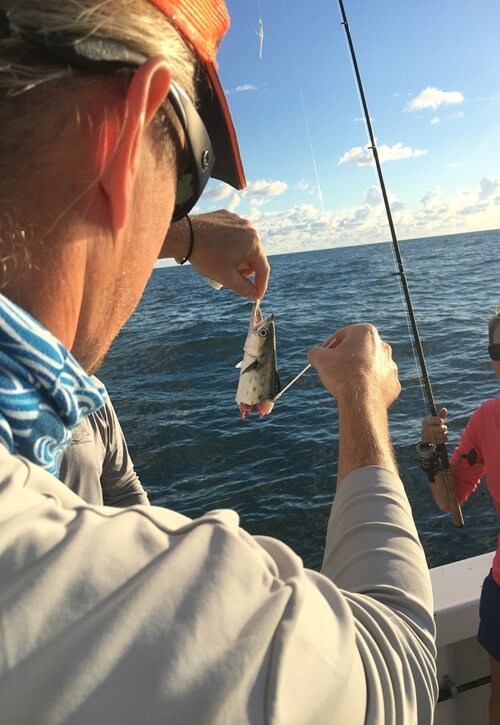
Researchers use a sterile swab on bite wounds from a depredated fish carcass to collect genetic samples to capture transfer DNA.
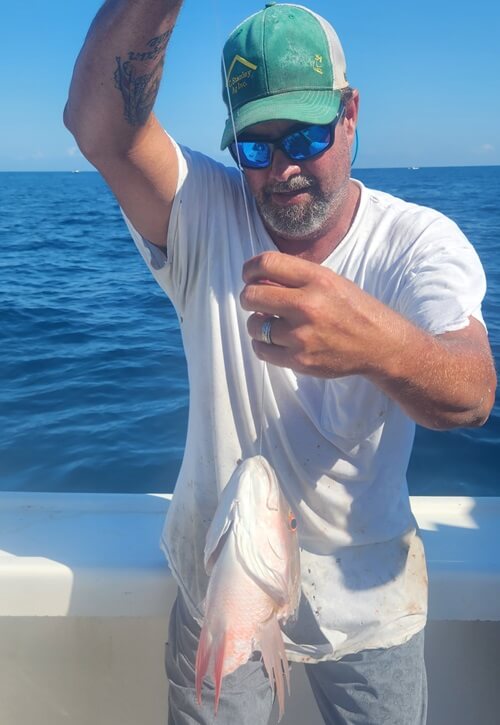
Shark depredation is a hot-button issue in recreational fishing, as anglers face off against these stealthy ocean bandits. These underwater thieves snatch fish straight off the line, often leaving nothing but scraps – or a broken leader – as evidence of their heist.
The Southeast, a major hub for saltwater fishing, is a depredation “hot spot” due to high fishing activity. While fisheries managers in the United States monitor shark depredation in commercial fisheries, efforts to evaluate these interactions in recreational fishing have been limited.
With Florida’s recreational fishing being economically vital and concerns about rising shark depredation, understanding its extent is crucial. A major research gap is identifying depredating shark species, as most events occur at depth and are rarely observed, making accurate identification difficult.
Florida Atlantic University Harbor Branch Oceanographic Institute researchers and collaborators have addressed these challenges by involving the public in citizen-science research. Using multiple methodologies that included social media, online angler surveys, cooperative fishery-dependent charters, and genetic analysis, the study uncovers the scope and impact of shark depredation in Florida’s recreational fisheries.
Results of the study, published in the International Council for the Exploration of the Sea (ICES) Journal of Marine Science, reveal that across methodologies, snapper-grouper species were the most frequently depredated target species group, and bull sharks and sandbar sharks were the most commonly identified depredating species. Findings show 43% of anglers experienced depredation and the probability of experiencing depredation ranged from 10% to 60% and varied both regionally and seasonally.
“Our research provides crucial insights into the growing challenge of shark depredation, helping to build a comprehensive understanding of this human-wildlife conflict and how different fishery sectors are being affected by it,” said Matt Ajemian, Ph.D., senior author, an associate research professor and director of the Fisheries Ecology and Conservation Lab (FEC) at FAU Harbor Branch.
For the project, Ajemian and his team collaborated with the University of Massachusetts Dartmouth, Cramer Fish Sciences, Mississippi State University, Mississippi-Alabama Sea Grant Consortium, and the Office of Sustainable Fisheries, National Marine Fisheries Service, from June 2020 to September 2023 to quantify frequency and impact and to analyze spatial and temporal trends.
Researchers analyzed the contents of the Facebook group, Sportsmen Fighting for Marine Balance, weekly to capture their perspectives. More than 6,500 members shared their depredation reports from Florida and elsewhere. Additionally, a quarterly online survey was distributed over a year to 4,000 randomly selected Florida saltwater fishing license holders to assess depredation trends and its impact on the fishery.
The researchers also partnered with local fishing charters to collect genetic samples from depredated fish carcasses. Sterile swabs were used on bite wounds to capture transfer DNA, but many depredation events resulted in “bite-offs,” leaving no carcass to sample.
“We quickly realized that getting those perfectly bitten carcasses that fishermen posted on social media was more the exception than the rule on the fishing charters,” said Michael P. McCallister, lead author of the study, a Ph.D. student, and research coordinator, FEC program at FAU Harbor Branch. “So, we had to quickly adapt in order to salvage those sampling events.”
To overcome this obstacle, researchers swabbed the ends of the monofilament fishing line as an alternative DNA source. It was the first time this technique was used and was successful on nearly half the time, showing promise for improving depredator species identification in both recreational and commercial fisheries.
Mutton snapper, red snapper and greater amberjack were three of the five most frequently depredated species in both the content analysis and depredation swab sampling submitted by participating charters. As the stock status of some of these species is concerning, information the researchers have provided on depredation rates of these species can help manage their recovery.
The frequency of depredation varied by season and region, with the highest occurrences in the spring and in the Florida Keys, as well as the southeast and southwest regions of the state. However, while season and region significantly influenced how often depredation occurred, they did not have a significant effect on depredation rates (the percentage of total catch lost to depredation).
“This finding suggests that other factors such as water depth, habitat type, fishing pressure, specific fishing locations, and fishing techniques may play a more direct role in determining depredation rates, influencing patterns on a finer scale beyond broader seasonal or regional trends,” said McCallister.
Shark depredation is a growing concern in recreational fishing worldwide, particularly in regions with high shark populations, such as Australia, the U.S. (Florida), the Caribbean, and parts of the Pacific.
“Our findings could help fishery managers in developing informed, science-based strategies to address shark depredation while balancing conservation and recreational fishing interests,” said Ajemian. “Additionally, this study underscores the power of citizen science. By engaging anglers directly, we can gather valuable data that might otherwise be difficult to obtain, ultimately leading to more effective and inclusive fisheries management.”
Study co-authors are Lauran Brewster, Ph.D., an assistant professor, School for Marine Science & Technology, University of Massachusetts, Dartmouth; Cheryl Dean, senior laboratory manager, Cramer Fish Sciences; J. Marcus Drymon, Ph.D., associate extension professor at Mississippi State University and marine fisheries specialist with Mississippi-Alabama Sea Grant; Clifford Hutt, Ph.D., fisheries management specialist, Atlantic HMS, NOAA Fisheries; and Thomas J. Ostendorf, a research technician, FEC program at FAU Harbor Branch.
The project was supported by the National Oceanographic Atmospheric Administration National Marine Fisheries Service through a grant from the Southeast Cooperative Research Program, awarded to Ajemian.
//
//
-FAU-
Latest News Desk
- Researchers Identify Most Efficient Reinforced Concrete Beam DesignAn FAU engineering professor and international collaborators from Metallurgical Institute in Ukraine and Ariel University in Israel, have identified the most efficient design for reinforced concrete beams.
- FAU Launches Emergency Medical Services FellowshipFAU's Charles E. Schmidt College of Medicine launched it's sixth fellowship to strengthen emergency care through Boca Raton Regional Hospital - part of Baptist Health - and fire-rescue partnerships.
- FAU Receives NIH Grant to Investigate Amphetamine AddictionWith this grant, the FAU research team will use tiny roundworms to study how amphetamines disrupt dopamine, aiming to uncover addiction mechanisms and train the next generation of neuroscience researchers.
- New Study Links NP Autonomy to Provider Shortage ReliefA new study from researchers at FAU highlights how temporary expansions in nurse practitioner (NP) autonomy during the COVID-19 pandemic helped alleviate shortages.
- FAU's Cheryl A. Krause-Parello, Ph.D., Awarded Fulbright U.S. ScholarCheryl A. Krause-Parello, Ph.D., received a Fulbright U.S. Scholar award to study Germany's research and education systems in the academic year 2025-26, focusing on funding and university support for research.
- BEPI Poll: Hispanic Economic Optimism FallsHispanic consumers are spending less as optimism about their economic outlook dwindles amid inflation and economic uncertainty, according to a poll from the Business & Economics Polling Initiative at FAU.